

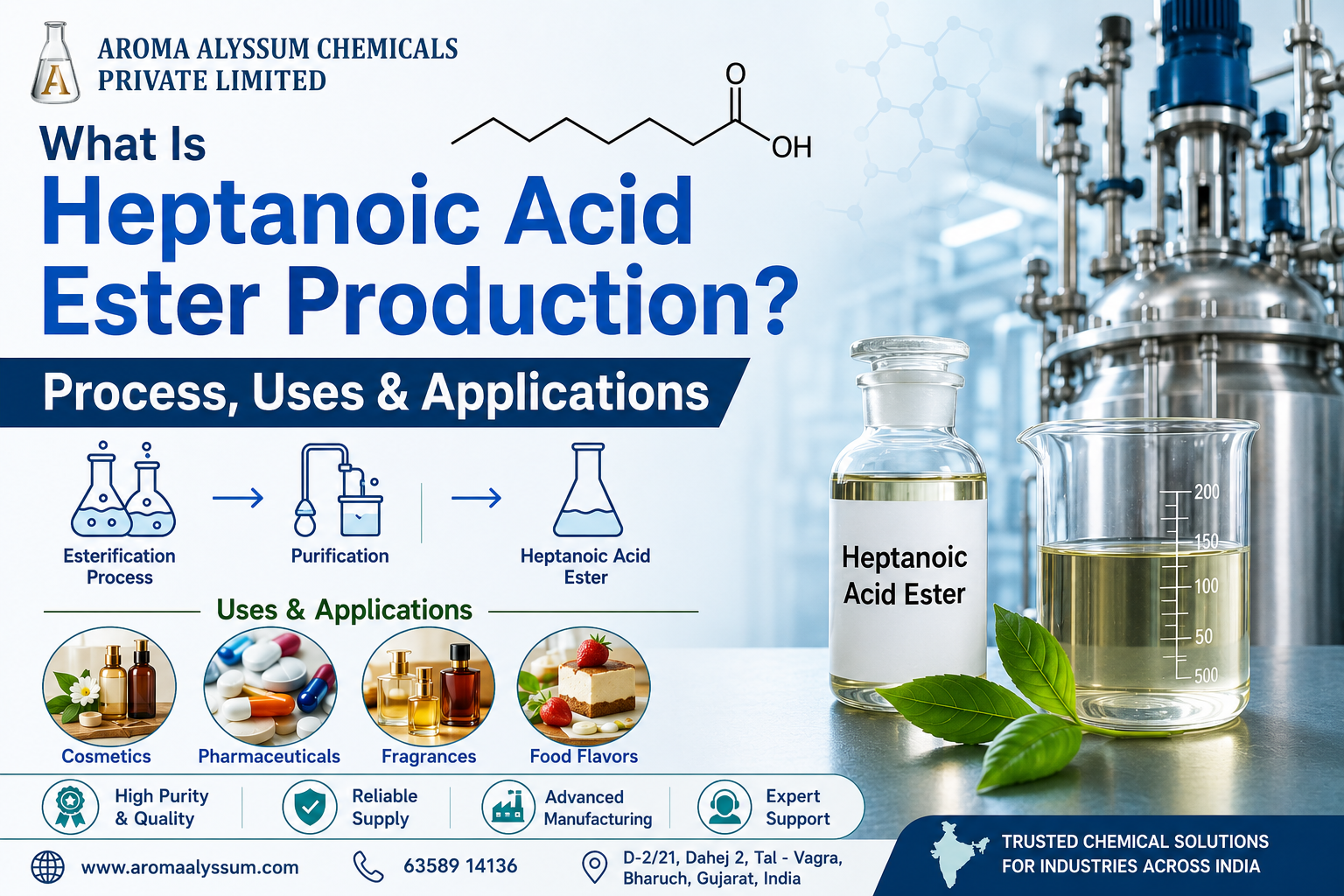
Ever wonder why so many synthetic lubricants fail? It usually comes down to one simple problem: they can’t handle high heat.
When standard oil-based formulas break down under pressure, performance tanks and machinery wear out fast. Tweaking your current blend rarely fixes the issue—the real solution is switching to specialised organic esters.
Understanding how heptanoic acid esters are made gives formulators a way to build stable, low-evaporation liquids that easily outperform standard petroleum products.
Where Does Heptanoic Acid Come From?
To get a high-yield ester, you have to start with the right foundation.
Heptanoic acid (you might also hear it called enanthic acid) is a straight-chain, seven-carbon fatty acid. Nature makes it in tiny amounts, but for industrial use, we extract it from plant feedstocks—specifically castor oil.
Castor Oil ──(Heat Breakdown)──> Heptaldehyde ──(Controlled Oxidation)──> Pure Heptanoic Acid
- Breaking down castor oil: Heating up castor oil splits it into two smaller pieces—a seven-carbon compound and an eleven-carbon one.
- Isolating the middle step: You then pull out the seven-carbon molecule (heptaldehyde). Working with a reliable supplier here is huge because any impurities at this stage will ruin your entire batch later on.
- Oxidation: Finally, that seven-carbon piece goes through controlled oxidation to turn into pure heptanoic acid.
Because of its balanced carbon chain, this acid reacts exceptionally smoothly in liquid formulations.
How does the Reaction Actually Works?
At its heart, esterification is pretty simple: you react a fatty acid with an alcohol (and a catalyst to speed things up) to produce an ester and water.

To keep the reaction pushing forward, you continuously pull the water out as it forms.
[ Heptanoic Acid ] + [ Alcohol (e.g., Polyol, Ethanol) ]
│
▼ (Heat + Catalyst)
[ Esterification Reaction ]
│
├─────────────────► [ Water Removed ]
▼
[ Clean Heptanoic Acid Ester ]
The Factory Process: Step-by-Step
Here is an even more natural, conversational rewrite that keeps all the steps and explanations crystal clear, without sounding too technical or textbook-heavy:
Step 1
Mix the Batch
Start by pumping your fatty acid and chosen alcohol into a clean reactor tank. These are usually made of stainless steel or lined with glass.
Why this step matters: Starting with clean equipment and getting the exact right mix of ingredients keeps unwanted chemical reactions from messing up your batch.
Step 2
Heat It with a Catalyst
Once everything is mixed, throw in a catalyst—a helper chemical—and crank up the temperature to kick off the reaction.
Why this step matters: Fatty acids and alcohols don’t react very fast at room temperature. The heat gives the molecules energy to move, and the catalyst acts as a chemical spark plug to speed the whole thing up.
Step 3
Pull Out the Water
As the acid and alcohol react, they produce two things: esters and water. You’ll need to continuously pull that water out of the tank as it forms while the batch cooks.
Why this step matters: If you leave the water in the tank, it will actually start breaking your newly formed esters back down into raw acid and alcohol. Pulling water out as fast as it forms forces the reaction to keep making as much ester as possible.
Step 4
Rinse Away Leftovers
Once the reaction finishes, let the mixture cool down a bit and give it a thorough rinse with mild, warm water.
Why this step matters: You don’t want any of that catalyst acid sitting in your final product—it can make the liquid corrosive or ruin its stability. A quick warm water wash sweeps away the leftover catalyst, leaving you with a clean, raw ester.
Step 5
Vaccum Distill for High Purity
Finally, pass the washed mixture through a vacuum distillation setup. Lowering the air pressure inside the equipment lets you boil and purify the ester at lower, safer temperatures.
Why this step matters: Extreme heat over long periods can scorch organic molecules. Using a vacuum lets you boil off any leftover raw ingredients safely, leaving you with a clear, high-purity ester that meets your exact specs.
Where Are These Esters Used?
Because these seven-carbon molecules handle brutal heat, stay fluid in cold, and don’t evaporate easily, teams rely on them whenever mineral oils fall short.
Formulators can easily tweak key features—like viscosity, flashpoint, and scent—depending on what the market needs.
Application Area | Primary Use | Why It Works |
Synthetic Lubricants | Jet engines, fridge compressors, car transmissions | Won’t freeze in extreme cold; won’t break down in high heat. |
Flavors & Fragrances | Perfumes, drinks, air fresheners | Delivers light, fruity notes (e.g., Ethyl Heptanoate for pineapple/grape, Allyl Heptanoate for tropical vibes). |
Industrial Coatings | Metalworking fluids, PVC softeners | Repels water to form a natural rust barrier on metal. |
Why Material Purity Makes or Breaks Your Batch?
Your final ester is only as good as the raw materials you put in. Trace acids, leftover water, or microscopic metal fragments can destroy a lubricant’s performance or ruin a delicate perfume scent.
Storage & Handling Tip:
Raw organic acids typically have a 12-month shelf life. Keep them tightly sealed in a cool, dry place out of direct sunlight, and make sure moisture stays out.
Partnering with a trusted supplier—like Aroma Alyssum Chemicals—ensures your materials arrive thoroughly tested, packaged under strict quality controls, and free from air moisture.
Quick Takeaways:
- Plant-Based Roots: Derived from renewable castor oil, offering a greener alternative to petroleum.
- Built for Extremes: Stays stable under high heat and intense physical pressure.
- Versatile: Drives everything from jet engine oil to tropical fragrance blends.
- Simple Care: Protect raw stock from moisture to keep quality high over its 12-month shelf life.
Frequently Asked Questions:
Describe the heptanoic acid ester production process?
This is a simple combination of heptanoic acid with alcohol, heating and catalytic action, resulting in the formation of synthetic esters, which is an extremely versatile compound that finds applications in different spheres.
Which applications for these esters are the most common?
Esters have many uses but are mostly applied in heavy-duty synthetic oils (jet engine or compressor oils), flavouring agents and fragrances, and metal protection coatings.
How does Aroma Alyssum Chemicals make sure its products are pure?
They carefully distil every batch and run thorough lab tests, so you know you’re always getting clean, reliable materials.
What is the shelf life of raw heptanoic acid?
It lasts 12 months, provided you keep the product properly – in tightly closed containers at room temperature, away from any moisture and sunlight.
Why choose castor oil rather than petroleum?
Being natural and renewable, castor oil is environmentally friendly and allows for esters with outstanding thermal and compression stability.