
Purpose of Blog:
To enable production managers, buyers, and formulation scientists to understand how heptanoic acid behaves within the factory and how it is superior to oil-based alternatives, along with its availability.
Introduction:
Have you ever been forced to shut down your whole production line because of an unexpected shortage or a sudden rise in prices by your raw materials supplier? For any industry, depending on unreliable, oil-based chemicals is a huge risk to your money.
Aroma Alyssum Chemicals provides a highly pure, plant-sourced solution that stops these performance hiccups and supply chain headaches for manufacturers worldwide.
Why Is This Organic Acid a Smart Choice for Industrial Oils?
There is no denying that industrial machines work under enormous pressure and heat. That is why it becomes imperative for plants to have high-pressure resistant oils that do not break down or evaporate under pressure.
Due to its simple structure, the seven-carbon fatty acid becomes a perfect raw material for developing polyol esters.
When production teams use these specific esters in jet engines, massive factory gears, or cooling systems, the lubricants last much longer without breaking down.
H H H H H H
| | | | | |
H—C—C—C—C—C—C—C═O
| | | | | | \
H H H H H H O—H
No business can afford unexpected downtime caused by cheap, low-grade chemical ingredients. Mixing this reliable component into your main oil blends directly cuts down on machinery wear and tear, saves you money on emergency maintenance, and keeps your hardware running smoothly without a hitch.
What Drives the Global Demand for Buying in Bulk?
Global Sourcing Variables:
[Volume Commitments] –> [Direct Price Stability]
[Sourcing Frameworks] –> [Supply Chain Security]
If you are running a hectic plant where cosmetic products, lubricants, or plastics are manufactured, there is nothing better for you than buying raw materials in bulk. Buying heptanoic acid in bulk price can give you a competitive price deal, which means that your production will be extremely profitable without sacrificing your standards.
Keeping your raw material costs predictable shields your business margins from sudden, unexpected price spikes in the global market.
- Purchasing through a centralized, high-volume supply plan makes it much easier to keep your product batches completely uniform across different factory locations.
Moving toward eco-friendly sourcing isn’t just a trend anymore—it’s where the whole chemical world is going.
Choosing a heptanoic acid castor oil derivative allows top brands to ditch oil-dependent ingredients and switch to completely renewable, plant-based options.
This simple upgrade directly lowers the carbon footprint of your finished products while matching the exact performance of traditional chemicals.
How Does It Help Make Better Flavors and Perfumes?
Esterification Cascade:
[Heptanoic Acid] + [Alcohols] ==> [High-Purity Esters] ==> [Target Aromas]
The companies that make everyday food flavors and perfumes need highly reliable building blocks to create accurate scents and taste profiles. When you mix this organic acid with different industrial alcohols under heat, it forms a group of ingredients called heptanoate esters.
Fragrance chemists love these esters because they naturally give off sweet, fruity tones and rich floral notes.
- Ethyl Heptanoate: Offers a clean and sweet smell that imitates the real smell of pineapples and grapes.
- Butyl Heptanoate: Gives a fruity taste and flavor, which helps in improving drinks manufactured by drink manufacturing firms.
- Allyl Heptanoate: Imparts a strong and tropical smell,l which is one of the components of costly air fresheners.
Keeping this raw material completely clean ensures that your finished fragrance blends don’t end up with weird chemical aftertastes or odd smells.
Blending labs depend on these exact intermediate ingredients to craft long-lasting scents that perform beautifully in consumer products.
Where Does This Chemical Show Up in Everyday Items?
This versatile chemical does way more than just upgrade heavy machinery oils and perfumes. It actually works behind the scenes in everyday items like tough outdoor paints, rust sprays, and even prescription medicines.
It has a great natural balance—it mixes easily with oils but completely shrugs off water. That is exactly why product developers love working with it.
- Outdoor Paints: It makes protective coatings more flexible so they do not crack, peel, or fade under the hot sun.
- Rust Blockers: It sticks tightly to metal surfaces, creating a waterproof shield that stops rust before it can even start.
- Medicines: It acts as a foundational building block that helps labs modify drug formulas so the human body can absorb them better.
Learning about these practical heptanoic acid benefits helps design teams build lighter auto parts and stronger industrial cleaners.
Because it combines eco-friendly sourcing with high-tier performance, it has quickly become a must-have ingredient for companies looking to build next-generation products.
What Is the Science Behind How It Acts?
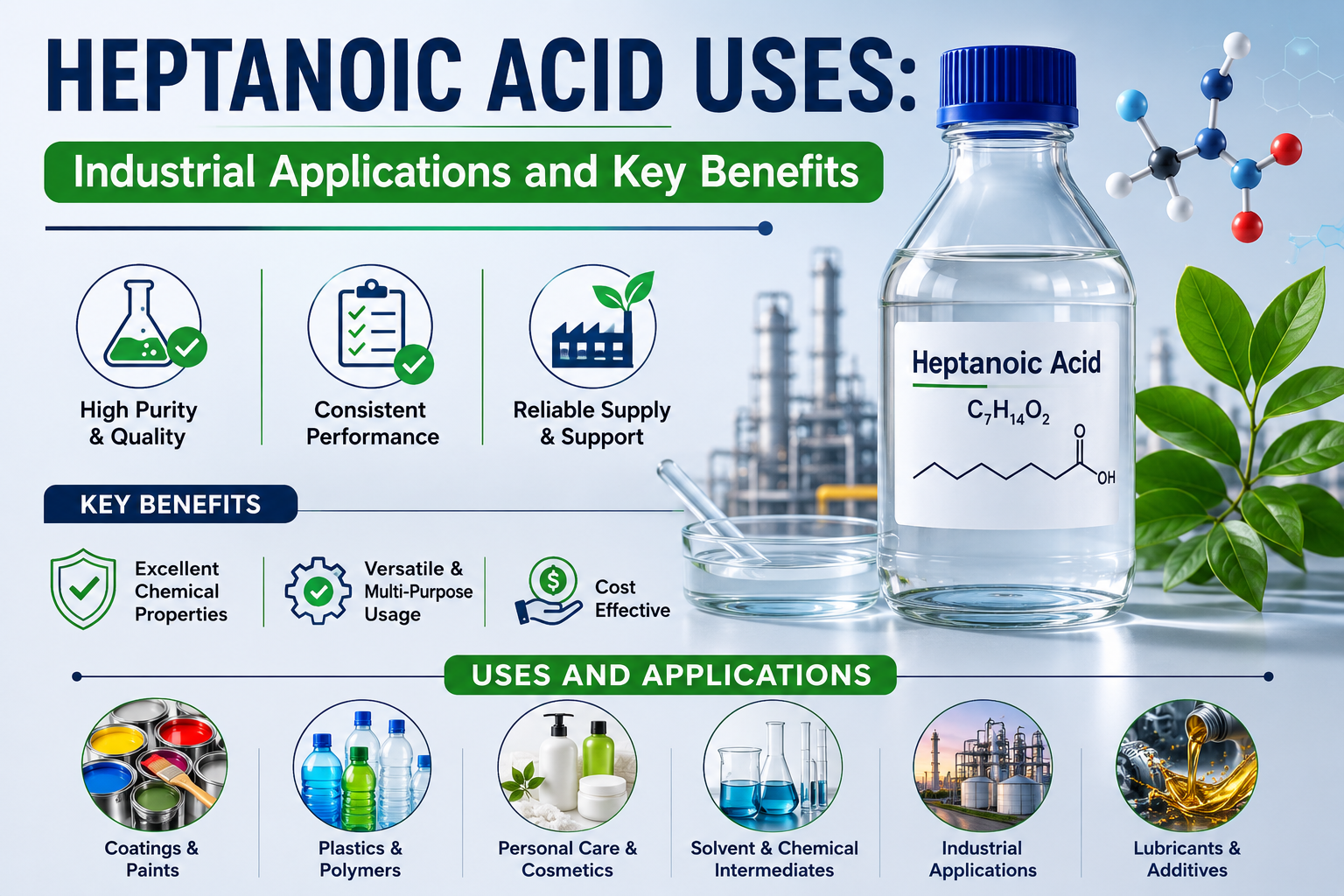
The way this fluid behaves in your mixing tanks depends entirely on its basic molecular architecture. Known by scientists as enanthic acid, the official heptanoic acid chemical formula is written simply as $C_7H_{14}O_2$.
This specific atomic layout keeps the chemical in a stable liquid form across a wide range of working temperatures, which makes pumping and mixing it in large factory vats incredibly straightforward.
Physical Property | Technical Value / Range | What It Means for Your Factory |
Molecular Weight | 130.18 g/mol | Helps your lab team calculate exact mixing ratios and batch sizes. |
Boiling Point | 223°C (433°F) | Keeps the chemical stable and safe when mixed under high heat. |
Melting Point | -10.5°C (13.1°F) | Ensures the material stays liquid in normal warehouse environments. |
Density (at 20°C) | 0.918 g/cm³ | Makes it simple to measure and pump accurately through factory lines. |
This clean molecular shape ensures that reactions remain predictable when creating complex chemical blends. Because the carbon chain is straight rather than tangled or branched, chemical processing teams can achieve high output yields with very little waste or unwanted chemical leftovers.
Who Gets the Biggest Boost From This Ingredient?
Using plant-derived chemical bases is helping modern agricultural and plastic companies stand out in a crowded market. Using a specialized heptanoic acid castor oil derivative gives formulation teams the power to create products that naturally break down safely in the environment after use.
- Targeted Farm Chemicals: Works as a highly effective, natural active ingredient or carrier liquid in modern weed sprays.
- Flexible Plastic Enhancers: Improves the bendability and crack resistance of industrial rubbers and vinyl products in freezing weather.
- Metal Cutting Fluids: Keeps tools sharp and cool by providing an ultra-slippery barrier under extreme factory pressure.
Working directly with an experienced producer like Aroma Alyssum Chemicals guarantees your plant gets a completely uniform stream of material. A steady raw supply chain means fewer headaches for your production team, allowing you to hit your delivery targets and keep your product quality flawless.
How Can Your Production Team Mix It In Successfully?
Getting the best results out of your production runs means setting up your equipment to handle the unique properties of this ingredient. Knowing the standard heptanoic acid uses across different industries helps your floor manager adjust temperatures and blending times to get maximum value from your raw materials.
1. Keep Your Containers Bone Dry
Before you put this organic acid into your blending tanks, make sure there is no trace of any water in them.
The presence of water will affect your chemical reaction process, reducing your overall yield and affecting the purity of the batch.
2. Watch Your Catalyst Balance
When you are blending esters for perfumes or high-grade oils, pay close attention to your chemical catalysts.
Keeping this balance right ensures your processing times stay short and prevents you from having to use excess heat, which can discolor the liquid.
3. Manage Your Processing Heat
Try to keep your reaction temperatures steady between 160°C and 200°C. This specific temperature range speeds up your mixing process while staying safely below the chemical’s boiling point, preventing evaporation losses.
Secure Your Chemical Supply Chain Now
Do not let unpredictable chemical costs or patchy ingredient quality slow down your factory output. Contact us now at Aroma Alyssum Chemicals.
We can discuss the specific level of purity that is right for you, send you a test sample, and arrange a steady supply chain for you.
High-Value Sourcing Takeaways:
- Eco-Friendly Foundation: Using plant-sourced chemical bases helps your company hit green targets without giving up performance.
- Stands Up to Heat: The straight-chain C7 molecular design keeps the chemical from breaking down under intense operational temperatures.
- Stable Budgets: Securing reliable bulk pricing deals keeps your production costs safe from erratic market changes.
- Massive Versatility: This single chemical works perfectly across aviation lubricants, skincare lines, and high-end fragrances.
FAQ’S:
How does heptanoic acid perform compared to petroleum-based options in oils?
This plant-based acid handles high heat much better and has a higher flashpoint than traditional petroleum options. Its molecular structure reduces machine friction incredibly well, which protects your equipment and helps you meet modern environmental regulations.
What is the best way to store this chemical to keep it pure?
The liquid should be kept in tightly sealed tanks made of stainless steel or HDPE barrels. The presence of sunlight or strong chemicals should be avoided. It is better to pump dry nitrogen into the storage tank as it prevents moisture.
Why is a castor oil source better for long-term supply chains?
Oil prices go up and down constantly due to international politics, but castor crops provide a stable, renewable farm harvest year after year. This steady farming cycle means predictable supply volumes and reliable delivery dates for your factory.
What safety precautions must be followed by the factory workers while using it?
Being a concentrated form of an organic acid, it may irritate the skin and burn the eyes upon exposure. The floor workers need to use protective gear such as rubber gloves and eye protection while working in rooms that have proper ventilation and functioning eye wash fountains.
How do heptanoate esters make up part of daily skincare products?
These particular esters function as extremely light-weight moisturizers that do not leave any oily residue after application. They mix pigments wonderfully and are absolutely non-irritant.