

Heptanoic acid is one of the essential organic compounds whose application ranges from chemical manufacturing, pharmaceuticals, lubricants to specialty formulations. Understanding its heptanoic acid formula and role in the production combined with growing demand is a must. At Aroma Alyssum, we support the global supply chain with consistent quality and reliable sourcing.
Enanthic acid or heptanoic acid is a straight-chain fatty acid and is very important in industrial chemistry for its reactivity, stability, and versatility.
What is the Heptanoic Acid Formula?
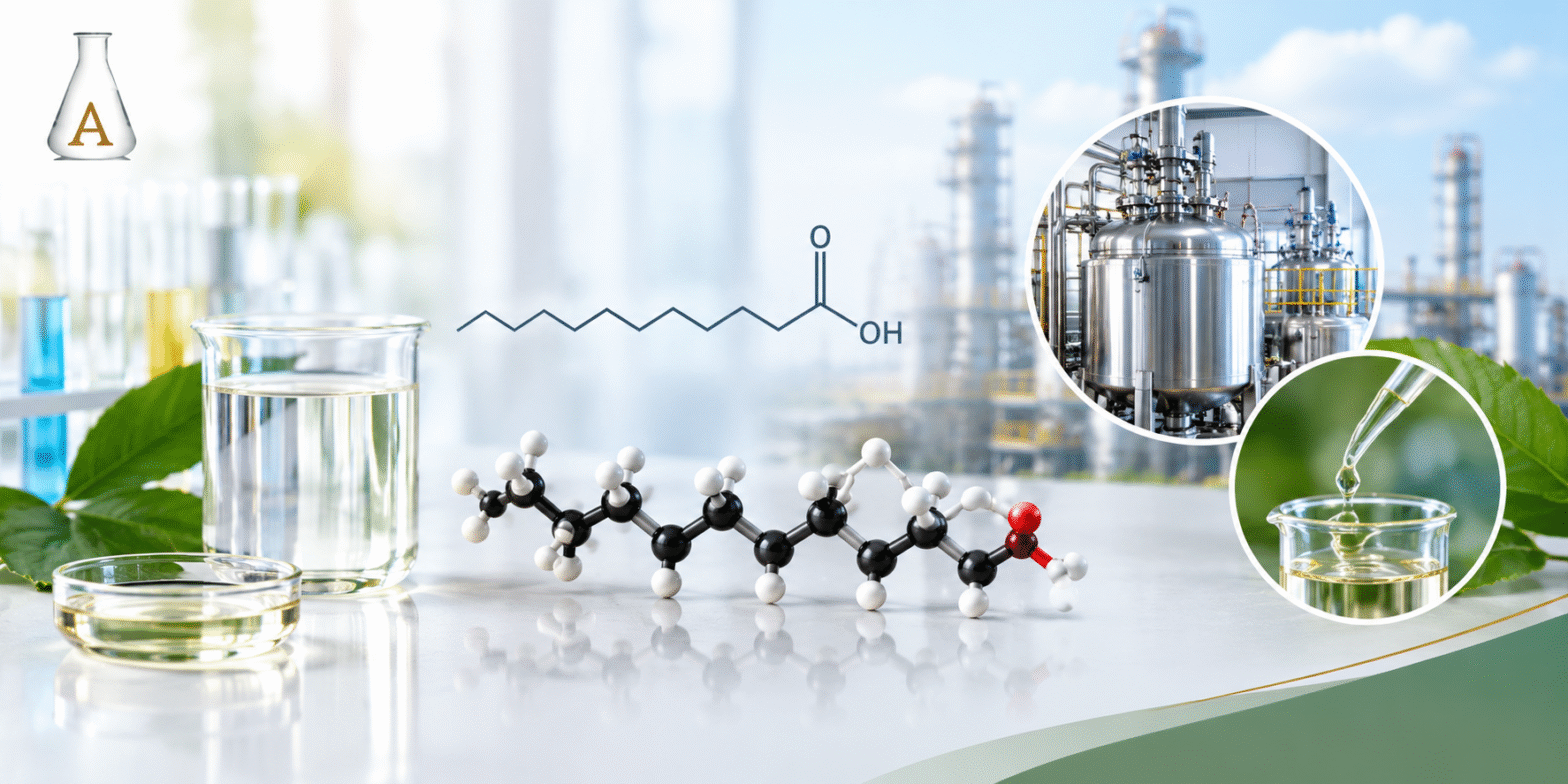
C₇H₁₄O₂ is the correct heptanoic acid formula. It is composed of a seven carbon chain with a carboxylic acid (-COOH) group at its other end. The presence of this group mostly results in the compound’s moderate acidity, behavior of the hydrophobic chain, and the ability to dissolve in organic solvents.
In terms of chemistry, this can be represented as:
CH₃(CH₂)₅COOH
This simple molecular composition yet functional can engage in various reactions such as esterification, oxidation, and salt formation, hence production processes derive great value from it.
Importance of Heptanoic Acid in Chemical Manufacturing
The chemical structure of heptanoic acid is the key element that determines the way it interacts with other substances chemically at the processing stage. The presence of a medium carbon chain in it is the balanced feature that offers both solubility and reactivity. Heptanoic acid is therefore a:
- Source for the production of esters (used in flavors and fragrance)
- Basic ingredient of lubricants, plasticizers
- Key component in pharmaceutical synthesis
- Corrosion inhibitors and chemical additives
The industries continue to drive up the demand for dependable heptanoic acid suppliers, especially when requirements are for high purity and consistency.
1. Raw Material Sourcing and Supply Chain Challenges
Production of heptanoic acid is primarily dependent on petroleum-derived raw materials or bio-based sources. Such a double-source system is a way of creating opportunities as well as the resulting challenges.
Any sudden changes in availability of raw materials would in turn affect both the costs and scheduling of manufacturing. For a chemical heptanoic acid bulk supplier, it is an ongoing challenge to both stabilize the supply and keep the quality intact.
2. Chemical Processing and Reaction Control
The industrial synthesis of heptanoic acid usually takes oxidation or synthetic routes as starting points which are then followed by temperature, pressure, and catalysts controls to produce the desired products.
The consequences of a process parameter change, even a very small one, could be a lower yield and purity of the product. As a result, a heptanoic acid distributor needs to make sure that the batches are reproducible in order to build and maintain partners’ trust and satisfy commitment over time.
Innovative processing technologies present new ways to enhance the efficiency whilst at the same time opening more doors for investment and expertise development.
3. Maintaining Purity and Quality Standards
Those industries including pharmaceutical and specialty chemicals have strict requirements for purity.
The heptanoic acid formula should not be subjected to contamination with unwanted by-products to be considered as high quality. The ways of quality assurance include analytical processes such as gas chromatography and spectroscopy.
Complying with international standards and certifications is a must for any heptanoic acid exporter.
The identity and concentration of the products play a significant role in their subsequent application performance.
4. Industrial Applications and Versatility
One good reason for the availability of various heptanoic acid products with different formulations and characteristics is that they are widely used in a number of industries. Hence, depending on the application:
- Fragrance & flavor intermediates
- Synthetic lubricants
- Chemical synthesis agents
- Agrochemical formulations
Such wide applicability drives the demand in both domestic and international markets, which, in turn, facilitates competitive heptanoic acid wholesale price structures.
5. Environmental and Regulatory Considerations
Nowadays, a chemical production plant is required to meet environmental constraints and regulations. Even though heptanoic acid is one of the most commonly used chemicals, its production and handling are subject to compliance with global regulatory requirements.
Manufacturers are initiated to go greener by adopting processes with a minimum impact on the environment, emissions reduction, and the opening of more recycling avenues while still efficient.
In his/her/her role as a responsible heptanoic acid supplier, one should consider the environmentally compliant first and foremost ethics without sacrifice of operational efficiency.
6. Storage and Stability Factors
Heptanoic acid is relatively stable but requires proper storage to maintain its chemical integrity. Exposure to heat, air, or contaminants can lead to degradation.
Proper packaging, sealed containers, and controlled environments are essential for safe transportation and storage. This is particularly important for companies operating as a heptanoic acid exporter, where long-distance logistics can impact product quality.
7. Role of Innovation and Technical Expertise
High-quality heptanoic acid production depends on the knowledge and skills of organic chemists as well as process engineers. These specialists contribute significantly to production efficiency and innovation.
Ongoing research and development lead to higher output, reduced waste, and better quality of the final product.
Efforts in these areas are especially relevant for a bulk supplier that aims to expand the business on an international scale.
Key Takeaways
- Heptanoic acid formula (C₇H₁₄O₂) determines its chemical characteristics and industrial usages.
- It finds extensive application in the production of pharmaceuticals, lubricants, and fragrance intermediates.
- Preserving purity and consistency is a must for succeeding in the industry.
- Raw material sourcing and supply chain stability are the main challenges.
- Market demand is mainly propelled by competitive pricing and quality assurance.
- Environmentally responsible production and sustainable operations are becoming a must.
Conclusion
Having a good grasp over the heptanoic acid formula is the main element for whoever is actively engaged in chemical manufacturing and processing activities. The simplicity of its structure added to the functional diversity makes it an industry-wide staple.
Wherever supply chain swings, regulatory changes and pricing pressures are constantly present, the market for very good quality heptanoic acid is always growing. Focusing on innovation, sustainability, as well as strict quality control, we at Aroma Alyssum are the ones who set the global chemical industry’s standard.
FAQs
The heptanoic acid formula is C₇H₁₄O₂, which consists of a seven-carbon chain and a carboxylic acid group.
Heptanoic acid finds applications in the formulation of lubricants, fragrances, pharmaceuticals, and also as a chemical intermediate in various industrial processes.
Maintaining high purity is necessary to ensure the uniformity in performance of an application especially in the cases of pharmaceuticals and specialty chemicals.
Global supply of heptanoic acid is carried out by an extremely small group of suppliers. At Aroma Alyssum, we provide high-quality products for diverse industrial needs.
It should be stored in tightly sealed containers, away from heat and contaminants, to maintain stability during storage and transportation.