In the evolving global chemical industry, demand for specialty aldehydes continues to rise due to their role in fragrances, pharmaceuticals, and industrial synthesis. Based on the report by Grand View Research, the global aroma chemicals market is expected to surpass USD 8.5 billion by 2026, driven by increasing applications in the personal care and food industries.
Heptaldehyde is one such chemical whose applications have been soaring lately owing to its wide range of uses and its commercial importance. Companies such as Aroma Alyssum, the big ones in the business, are the ones facilitating other industries to get hold of high-purity heptanal for different purposes, therefore, making it a valuable compound across multiple sectors.
What is Heptaldehyde?
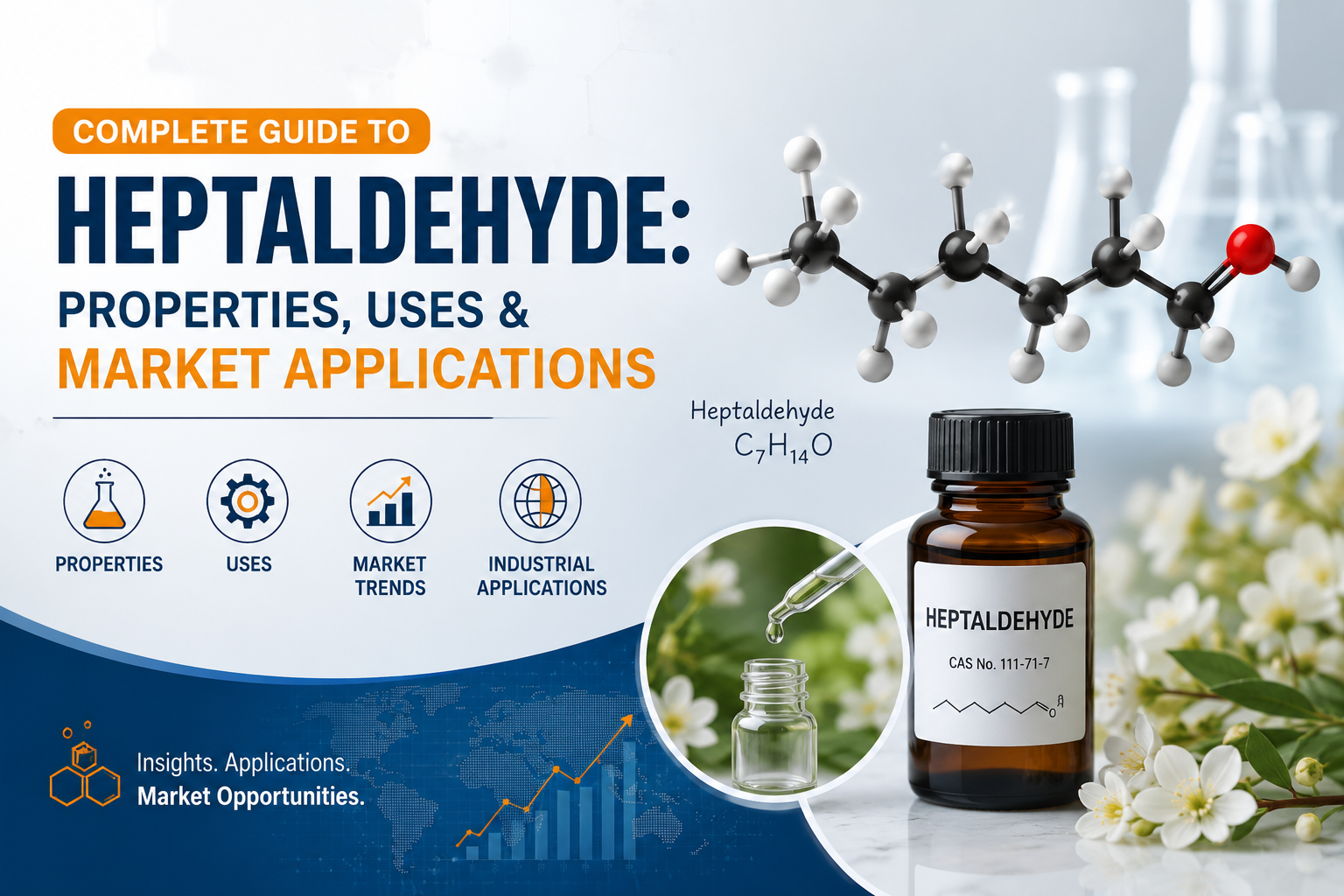
Heptaldehyde, or heptanal, is a straight chain aldehyde with formula C₇H₁₄O. It is a colorless liquid having a strong odor reminiscent of fatty citrus and thus it is one of the top products used for making fragrances and flavors.
Key Heptaldehyde Properties
Knowing heptaldehyde properties will help one understand the high level of its industrial significance:
- Molecular Weight: 114.19 g/mol
- Boiling Point: ~153°C
- Odor Profile: Fatty, citrus, green
- Solubility: Slightly soluble in water, miscible with organic solvents
- Stability: Reactive due to aldehyde functional group
These heptanal properties and uses make it highly suitable for chemical synthesis and aromatic applications.
Chemical Characteristics and Reactivity
The aldehyde functional group (-CHO) makes heptaldehyde highly reactive. It can be oxidized, reduced, and condensed so it serves as an intermediate in organic syntheses.
From an industrial perspective, heptanal properties and uses are closely tied to its ability to:
- Form alcohols through reduction
- Convert into acids via oxidation
- Participate in aldol condensation reactions
Basically, this compound has become vital for the chemical industry because of these transformations.
Major Heptaldehyde Uses Across Industries
The heptaldehyde has a wide range of applications across industries. The most notable applications are listed below:
1. Fragrance and Perfume Industry
One of the most significant heptaldehyde applications is in perfumery. It has a citrusy and fatty smell which improves the fragrance compositions.
- Commonly used in soap, detergent, and makeup products
- Works as a fragrance base note booster
- Could be combined with floral and citrus scents
Its ability to add depth makes it a staple in high-end fragrance formulations.
2. Flavor Industry
In the food and beverage sector, heptanal uses include flavour enhancement.
- Provides citrus-like notes in flavor blends
- Used in trace amounts for food-grade applications
- Enhances natural flavor perception
These heptaldehyde properties make it suitable for controlled flavour development.
3. Chemical Intermediate
A major portion of heptaldehyde industrial applications lies in its role as an intermediate.
- Used in synthesis of plasticizers
- Helps produce pharmaceuticals and agrochemicals
- Acts as a precursor for specialty chemicals
Due to its chemical properties, heptaldehyde is a favoured starting material for making a wide array of complex compounds in a cost-effective manner.
4. Pharmaceutical Sector
In pharma manufacturing, heptaldehyde applications include the following:
- Step in production of active pharmaceutical ingredients (APIs)
- Participation in organic synthesis routes
- Assistance in formulation research
With the increasing demand for high-quality compounds, the dependence on suppliers such as Aroma Alyssum for reliable quality has also grown.
5. Industrial Manufacturing
Heptaldehyde industrial applications extend to coatings, lubricants, and resins.
- Used in polymer production
- Enhances chemical formulations
- Acts as a building block for industrial compounds
These heptanal uses highlight its importance in large-scale manufacturing.
CTA: Looking for consistent, high-purity heptanal supply?
Market Demand and Growth Trends
The increase in demand for aldehydes such as heptanal is mainly because of:
- Growth in personal care and cosmetics
- Expansion of the food flavoring industry
- Rising pharmaceutical production
The surge in heptanal uses is also driven by sustainability trends, where manufacturers seek efficient and versatile intermediates.
Emerging markets in Asia-Pacific and Europe are particularly driving consumption, with industries focusing on high-performance chemical compounds.
Safety and Handling Considerations
While talking about the characteristics of heptaldehyde, a very important point is the safety concern.
- Flammable liquid — requires proper storage
- Can cause irritation upon contact
- Should be handled with protective equipment
Industrial handling in a proper way is a very important key for the safety of the usage of heptaldehyde in all of the applications.
Why Quality Matters in Heptaldehyde Supply
When selecting a supplier, the consistency and purity of the products they offer are extremely important factors. Contaminants may affect the following:
- Fragrance stability
- Chemical reactions
- Product quality
Trustworthy suppliers such as Aroma Alyssum are committed to:
- High-purity standards
- Batch consistency
- Global supply capability
CTA: Connect with our experts to streamline your sourcing process.
Future Outlook of Heptaldehyde Applications
The future of heptaldehyde applications looks promising, with new uses coming in:
- Eco-friendly chemical production
- Producing fragrant materials in a sustainable way
- Highly efficient drug manufacturing
As industries change, the features and uses of heptanal will still be a source of innovation and creation of new products.
Conclusion
In summary, heptaldehyde has extensive applications across fragrances, flavors, pharmaceuticals, and industrial production, thereby it is a very versatile chemical compound. Its unique reactivity and aromatic profile ensure continued demand in global markets. Partnering with reliable sources such as Aroma Alyssum, companies can have access to top-notch heptanal customised to their industrial requirements.
FAQs
What are the chief uses of heptaldehyde?
Heptaldehyde finds its major applications in making fragrances, flavors, and as a chemical intermediate in the pharmaceutical and industrial manufacturing sectors.
What are the main characteristics of heptaldehyde?
It is a colorless liquid with a fruity, citrus-like smell, a moderate boiling point, and quite reactive because of its aldehyde group.
What are different ways industries use heptanal?
Heptanal is used for making fragrances, enhancing flavors, and production of speciality chemicals and active pharmaceutical ingredients (APIs).
Is it safe to use heptaldehyde?
Yes, but one should take the necessary safety measures including wearing protective gear and storing it properly as it is a flammable material.
In what ways does heptaldehyde add value to manufacturing?
Its capability of undergoing chemical reactions and the ability to be used in different ways, makes it a very important material for the production of a lot of industrial and pharmaceutical compounds.