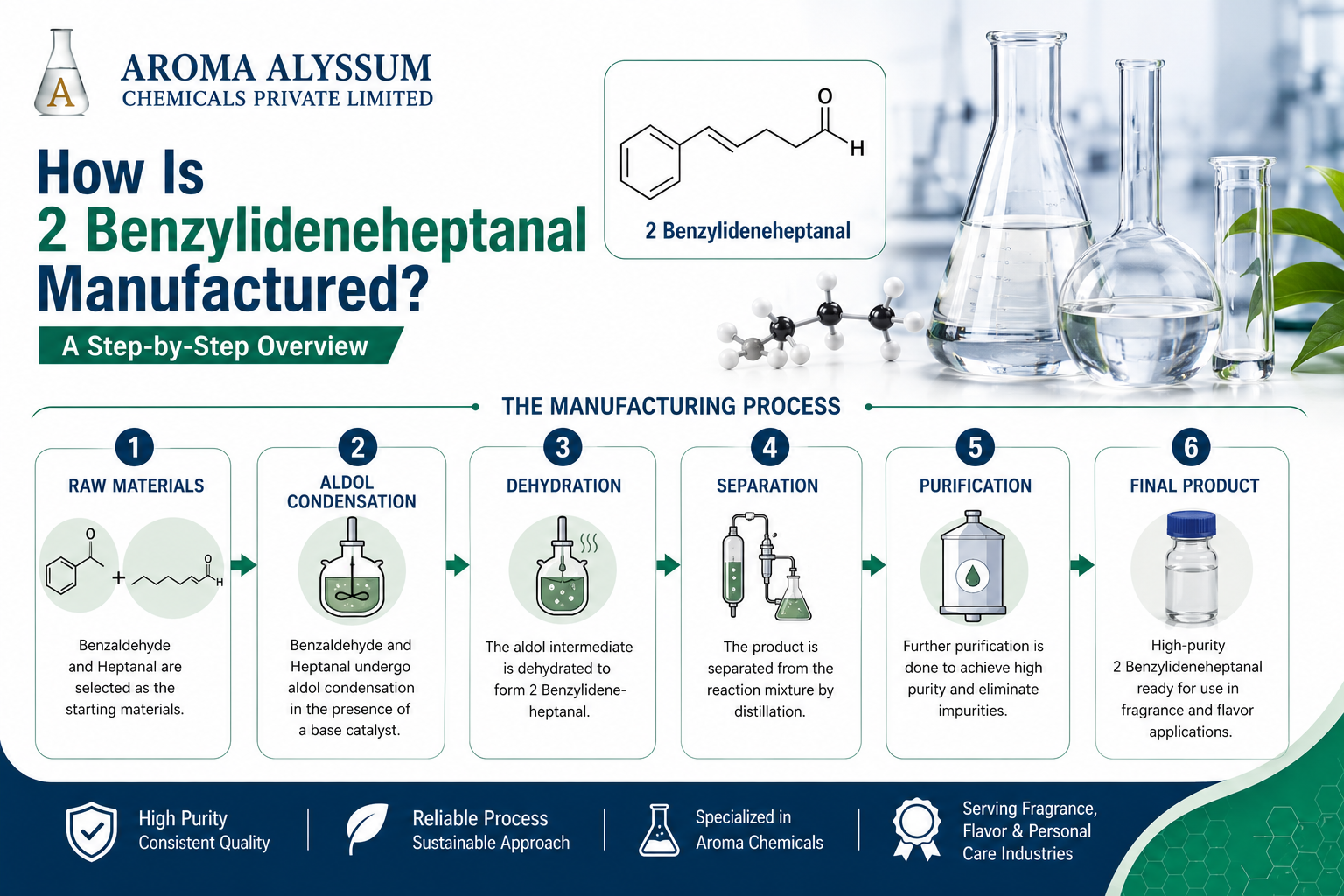
To explain the step-by-step industrial chemical process of manufacturing 2-benzylideneheptanal. To obtain the highly purified perfume substance, we just need to combine benzaldehyde with heptanal and then purify the remaining substances through vacuum distillation. Below is the process of synthesis.
Ever wondered why your favorite shampoo and perfume always give off a sweet jasmine fragrance that can last throughout the entire day?
Well, there is something more than a coincidence about that; it is actually due to the highly sought-after 2-benzylideneheptanal component.
In our capacity as 2-benzylideneheptanal manufacturers, we at Aroma Alyssum Chemicals have what it takes to manufacture this component in the best way possible. So here is a closer look at our process.
What Exactly Is 2-Benzylideneheptanal?
Before we look at the chemistry, let’s talk about what makes this molecule so special to perfumers. Chemically, this liquid is famous for its long-lasting scent profile, which brings a natural depth to products.
Olfactive Profile: It has a sweet, floral, oily, fruity, and herbal jasmine scent.
Because of this beautiful profile, the typical recommended application for the compound includes fine fragrances, beauty care, hair care, and laundry care products.
When you want to buy this compound in bulk, you will likely work with an Amyl cinnamaldehyde bulk exporter in India to secure your supply.
This product, widely tracked under the chemical name alpha amyl cinnamic aldehyde CAS 122-40-7, requires a highly stable setup to manufacture safely.
If you look closely at your favorite products, you’ll often see 2-benzylideneheptanal on the ingredient list.
What Raw Materials Do We Start With?
To make this fragrance, we don’t start with flowers. Instead, we start with raw, high-quality organic chemicals.
The manufacturing process is basically a crossed-aldol condensation, which needs two primary ingredients:
Raw Material | What It Does | Why It Matters |
Benzaldehyde | Provides the rich aromatic benzene ring | Used in excess to prevent side reactions |
Heptanal | Provides the flexible aliphatic carbon tail | Often sourced naturally from castor oil |
We keep a very close eye on the ratio of these two ingredients during the early setup.
We must use a high amount of benzaldehyde to make sure it completely reacts with the heptanal.
This careful ratio is what allows us to produce high-grade alpha amyl cinnamic aldehyde CAS 122-40-7 without wasting raw ingredients.
How the Chemical Reaction Happens
Once our ingredients are ready, we mix them inside a clean reactor vessel to start the chemical transformation. We use a basic catalyst like sodium hydroxide to get things moving at a lower, safer temperature.
1. Catalyst Mix
Adding the base
We add dilute sodium hydroxide to the reaction mix to start the process.
2. Enolate Formation
Creating the active molecule
The base pulls a proton from the heptanal, turning it into a highly active enolate.
3. The Attack
Linking the molecules
This active enolate attacks the benzaldehyde, binding them together into a single chain.
4. Dehydration: Removing water
The molecules lose a water molecule, leaving behind the stable aromatic structure.
Working with a certified alpha amyl cinnamic aldehyde manufacturer ensures this step is monitored by gas chromatography to keep the reaction clean.
Cleaning Up the Raw Chemical Mix
Once the reaction finishes, the mixture inside our vessel is highly basic and full of raw materials we need to clean out. We add a gentle acid like acetic acid to neutralize the catalyst and bring the pH back to a safe, neutral level.
[Crude Mixture] ──► (Add Acid) ──► [Neutral Mixture]
│
┌────────────────┴────────────────┐
▼ ▼
[Organic Layer] [Aqueous Layer]
(Contains raw fragrance) (Contains salt/water)
│ │
[Kept for Distillation] [Drained Out]
This separation lets us drain away the dirty water layer while keeping the rich organic oils at the top.
As a global manufacturer, alpha amyl cinnamic aldehyde CAS 122-40-7 must be washed repeatedly with fresh water to ensure all leftover salts are completely gone.
Refining the Compound with Vacuum Distillation
Even after washing, the organic oil contains unreacted raw materials that would ruin the final scent. To fix this, we put the washed oil through fractional vacuum distillation.
- Gentle heating of oil: Using a high vacuum, we reduce the boiling temperature. Thus, we avoid heating the sensitive oil, which might lead to spoiling its aroma.
- Light substance separation: In the first place, all remaining liquid and solvents evaporate. We gather them for future recycling.
- Collection of desired substance: After that, we slightly increase the temperature to collect the desired colorless pale yellow liquid.
- Disposal of undesired substances: All other heavy, dark, and viscous components remain on the bottom of the vessel and are thrown away.
Choosing an experienced amyl cinnamic aldehyde supplier in India guarantees that this distillation step achieves a purity of 95% or higher.
How We Protect the Final Product
Aldehydes are naturally sensitive to air and can spoil if they react with oxygen over time. To keep the quality perfect, we add a tiny, safe amount of food-grade antioxidants to the liquid.
Then, we pack the liquid into clean drums and flush out any remaining air with pure nitrogen gas.
When you buy from a trusted 2-benzylideneheptanal manufacturer, you get a product that stays fresh for a long time.
This careful packaging process guarantees a stable shelf life of 12 months when stored under cool, dry conditions.
Ready to Source High-Quality Ingredients?
When you are making great products, it is important that you have high-quality ingredients that you rely on. This is exactly why here at Aroma Alyssum Chemicals, we use modern equipment and strict testing to ensure quality production and give you the best batch. If you are looking for a trusted one of our valued 2-benzylideneheptanal manufacturers, feel free to contact us anytime!
Key Takeaways:
- The Reaction: Built on a crossed-aldol condensation of benzaldehyde and heptanal.
- The Catalyst: Add a little bit of sodium hydroxide (essentially lye) to help the reaction run smoothly and safely at a much lower temperature.
- The Refining: Requires high-vacuum distillation to keep the delicate aroma from burning.
- The Protection: Kept stable for a 12-month shelf life using nitrogen flushing and BHT.
Frequently Asked Questions:
What’s the CAS number for this aroma chemical?
It’s 122-40-7. Think of this number like a unique ID code. It is used by scientists and businesses all over the world, so everyone knows they are talking about this same compound.
Why do you have to use vacuum distillation?
Because these delicate fragrance molecules can easily burn! By using a vacuum, we lower the boiling point of the mixture. This lets us clean and purify the ingredient at a much lower, safer temperature so we don’t ruin the scent.
Is heptanal actually natural?
Yes, it usually is! The heptanal we use in our process is actually made from natural castor oil. This makes it a great, eco-friendly starting ingredient for our production.
What kinds of products use Aroma Alyssum Chemicals’ ingredients?
You’ll find our premium batches in all kinds of everyday items—from high-end perfumes and body lotions to daily shampoos and fresh-smelling laundry detergents.
How do I store this chemical so it doesn’t spoil?
It’s pretty simple: just keep it in its original, tightly sealed container in a cool, dark spot. Keeping it away from heat and air is the easiest way to make sure it stays fresh for its full 12-month shelf life.